She Hit Record—and Saved 300 Hours a Month
SpecSnap AI
From “How Do We Do This Again?” to “It Just Runs”: A Story of Turning Videos into Hundreds of Hours Saved
On a Tuesday that felt like every other Tuesday, Maya opened her laptop and sighed before she even logged in.
She wasn’t tired because the work was hard. She was tired because it was the same.
Download a report from a vendor portal. Copy the rows. Clean the format. Paste into a spreadsheet. Compare against last week. Spot the mismatches. Log into the CRM. Update records. Send the “quick update” email. Create the follow-up tasks. Repeat.
By the time she finished, the morning was gone—and somehow the day felt like it was already slipping away.
Maya ran Ops at a growing company with smart people and big goals. But her team was spending their best hours doing the kind of work that never shows up in a headline:
busywork.
glue work.
The invisible labor that keeps the business moving but quietly drains everyone.
They had tried the usual solutions. A few Zapier workflows. Some scripts an engineer built “real quick.” A Notion page of SOPs that was already out of date.
It helped… for a week.
Then a portal changed a button, a field name moved, an exception appeared, and the automation broke. The script became “tech debt.” The SOP became a museum exhibit.
So Maya did what a lot of operators do when something is broken but urgent:
She built a patchwork of heroics.
The problem with heroics is they don’t scale.
The day she hit her limit
It happened during month-end. The same fire drill. The same scramble. The same late-night messages.
Maya watched her team doing the work in a Slack huddle and realized something uncomfortable:
They weren’t struggling because they didn’t know what to do.
They were struggling because the company had turned human beings into a workflow engine.
And that was the moment she decided to try something different—something almost laughably simple.
She didn’t write requirements.
She didn’t book a workshop.
She didn’t ask engineering for a sprint.
She opened her screen recorder.
“I’m just going to show you what we do.”
Maya recorded the first video in one take. Ten minutes.
She narrated as she went: where she clicked, why she checked certain fields, what usually goes wrong, and what to do when it did.
Then she recorded the second video: onboarding a new customer in their systems.
Then a third: creating and updating records across a few tools.
Then another: generating the weekly ops report and sending it out.
Each video was a slice of reality—messy, specific, full of “if this happens, do that” moments that never make it into a clean flowchart.
By the end of the week, she had recorded several videos. Not polished training content. Not a course.
Just the truth of how work actually got done.
What came back wasn’t just documentation
A few days later, Maya opened a link and sat up a little straighter.
There it was:
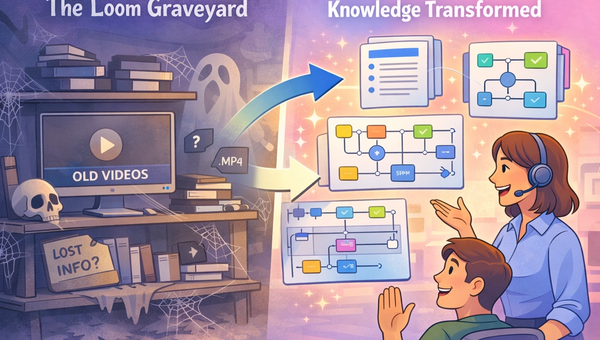
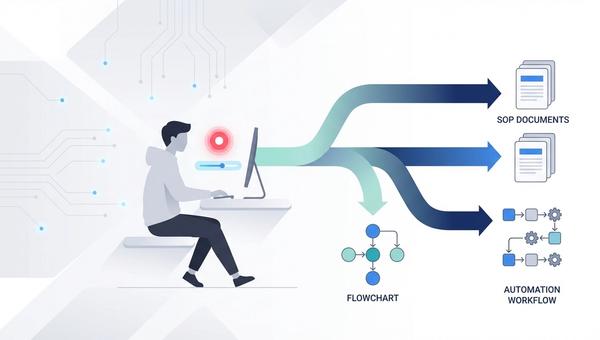
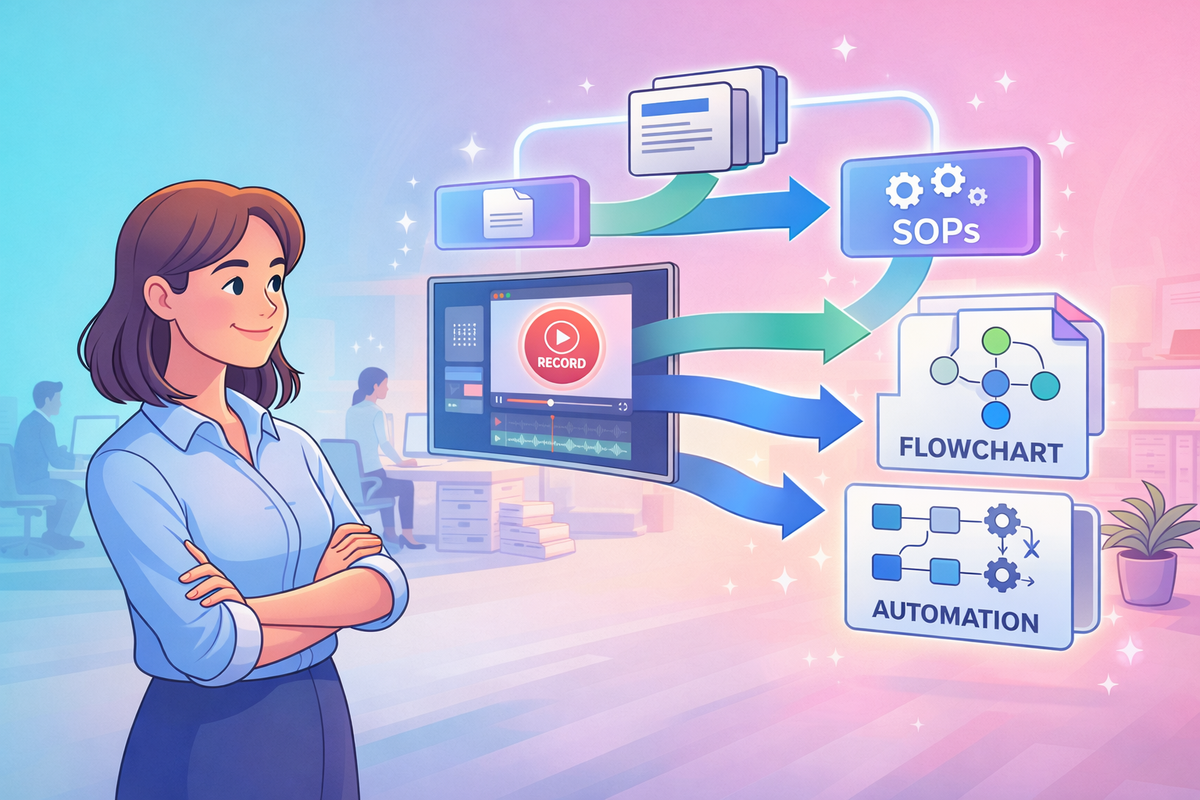
- Step-by-step SOPs with screenshots
- Process maps that made the handoffs and decision points impossible to ignore
- A short list of “here’s where time disappears and errors creep in”
And then the part she didn’t expect:
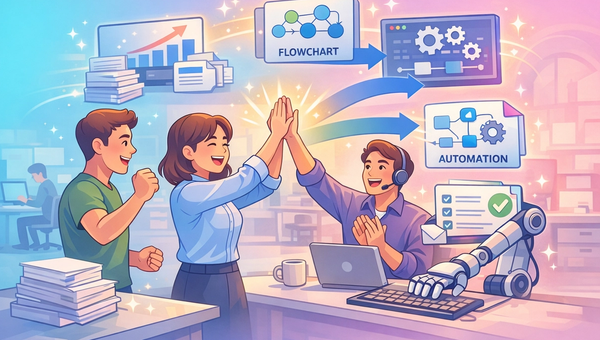
Automations—built from those videos—ready to run the workflow end-to-end.
Not “here’s a tool, good luck.”
Not “now assign someone to maintain it.”
But actual automations that did the boring parts exactly the way her team had demonstrated—while handling the branches and exceptions that usually break simple scripts.
Maya ran the first one with a little skepticism.
It worked.
She ran it again.
It worked again.
She pulled in two team members. They watched it run like people watching a dishwasher the first time after washing dishes by hand for years.
Someone laughed and said, “Wait… is it just going to do this now?”
And Maya, half joking and half dead serious, replied:
“I think we just got our mornings back.”
The quiet math of hundreds of hours
The savings didn’t arrive as fireworks. They arrived as something better:
silence.
No pings about portal exports.
No reminders about CRM cleanup.
No late-night “can you double-check this number” messages.
The team started noticing that tasks simply… didn’t need them anymore.
They ran the numbers after a month.
Across the workflows they’d automated from video recordings, they were saving hundreds of hours every month—hours that had been burned on copying, pasting, checking, reformatting, updating, and re-sending.
It wasn’t just time. It was the constant switching. The mental tax. The “don’t mess this up” anxiety.
And then something unexpected happened: the team stopped feeling behind all the time.
What they did with the time mattered more than what they saved
You can measure hours saved.
But what Maya cared about was what came next.
Instead of chasing the work, her team started improving it.
They fixed upstream issues.
They redesigned handoffs.
They built better customer experiences.
They started proactively finding bottlenecks—not because they had to, but because they finally had oxygen.
Maya told me later:
“It’s not that we didn’t have smart people before. It’s that we were spending their intelligence on tasks that didn’t deserve it.”
And that’s the real shift—when automation stops being a “nice-to-have” efficiency project and becomes a way to protect human attention for what only humans can do.
The simplest starting line
If you’re reading this and you can already hear the objection forming—
“We’re too busy,” “our process is complicated,” “we’ll automate later”—
I get it.
Maya was there too.
Her breakthrough wasn’t a new tool or a big initiative.
It was a decision:
Stop trying to explain the work in words.
Just show it once.
Record the workflow. The real one. The one you hate doing.
The one your team repeats until they’re numb.
Because when you capture work as it’s actually done, you can finally do something powerful with it:
Document it. Improve it. And then—most importantly—make it run without you.
And the next Tuesday?
Maya opened her laptop.
And for the first time in a long time, she didn’t sigh.
She smiled—because the tedious work was already getting done.
Without her.
Connect with us today. We’ll help you automate the boring work, just like we did for Maya!